30 oct 2012

Chapter 3, intresting quotes


Now I will present 3 important quotes from the third chapter of the book "Fatelessness" and analyze them using the PEE structure, explained some posts below.


1: The idea of Nazi superiority is expressed in the book, where Jewish population is segregated, in a way of racism. “He turned toward the gendarmes, ordering them, in a bellow that filled the entire square, to take the whole Jewish rabble off to the place”. This quote is said by the protagonist of the story, when he is entering the “labor camps” for first time. The meaning of this quote is that Jewish are an inferior group, that should be commanded by the Nazis.

2: Georg was astonish when he first enter the labor camp, and he realize that it was worse than he thought they were. “ They led us on into a maze of gray buildings, before we suddenly debouche onto a huge open space strew with a #141414 gravel”.  This clearly represents the protagonist feeling of fear, because of it’s unknown reality.

3: The idea of concentration camps was something unknown for the Jewish population. They were eager to figure out what was going on. “The attempted mainly to figure out what consequences the episode might have for them; from what I could hear, thought, there were about as many different views as there were men”. This quote is said by the protagonist as he observes a group of grown up Jewish workers, that gathered together to discuss about the police actions of stopping them wail going to work. The meaning of this quote is that people didn’t know what to do when policemen stop their buses.

Written task


That Girl
Alberto García
IIM°A

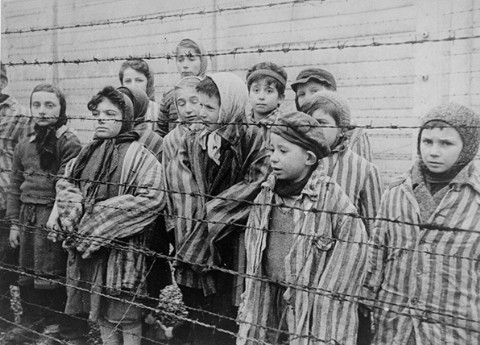
            They got us all Jewish people out of the bus. I was obligated to wait there under the burning sun until some Nazi would decide to move, but it was an interesting and different opportunity to know other people. After a while, I could not avoid looking at a girl that was at the end of the disoriented crowd: a little girl, I would say seven years old, blond haired and with a light blue dress ruined by a yellow star in her chest.
            She seemed to be on her own; sadly looking at the ground. I decided to go and talk to her. As I walked through the crowd, that felt like walking through a night full of stars, I saw her turning every time sadder. Every second, as I walked... I first saw her without any kind of smile, her skin was turning pale white, a tear went out of her blood injected eyes falling towards the ground.
            It was such a horrible thing to see, but I continued my way towards her. As I was next to her, I said kindly -"Hello there!" She didn't made any movement, but opened her mouth for less than half a second to answer -"Hi". I asked her afterwards if everything was all right, and I received a bigger answer than I expected:
            -"If you really want to know", she said with a beautiful voice, but covered in melancholy with sorrowful depression, and suffering. "I am alone in this world now, my parents were murdered a while ago". She paused for a moment. "I'm not that alone though, misery loves my company" -"Oh my god!" I said "I'm so sorry to hear that" She looked at me -"I won't worry for something like that, they were old already, my mother was 79 and my father 82, but what really affects me was how they died".
            I was there, sure that I will have to wait for hours, and there were no signals of something going on soon, so I decided to ask this girl her story.
            -"My father, who adopt me three years ago, was one of the most important people in all Hungry. He... he was too worried about making all of our people in this country to feel home, and was making plans for equality for everyone and everything, but everything changed when the Nazi regime attacked."
            I interrupted her a second. -"I'm sorry, I didn't ask your name" -"Arella" She said. -"Arella! What a beautiful name" I answered. -"My name used to be Keffhira, but my stepfather decided it was a horrible name, so I decided to call me Arella." I smiled. "-Well, my father had a lot of work to do all the time, and few days ago, he was sent to a labor camp, but he remain hidden, and when Nazis enter our home looking for him, they took my mother. There was a gunshot, and right after that, he ran out of his hideout, took a look outside, and he began to cry. The next day, he started moving a group of people to protest against the Nazis; that group you see over there!" And she pointed with her finger at a group of people outside the place we were locked in, with their hands in the wall looking downwards. We heard a countdown. -"5! 4! 3! 2! 1! Shoot!" and he hear a lot of explosions and all the "group" falling to the ground. -"OH JESUS CHRIST!" I said. -"My father ended like them in the morning, and I was present. the last thing he said was "I will avenge my town, I swear I wi..." they didn't let him finish, and his body fell to the ground.
            The Nazis made us begin to move and march though the streets. I got separated from Arella, couldn't say  goodbye, but the walking gave me time to think, and realize that for the Nazis, all Jews were all the same, independent of their "society rank", we were just "Jews" for them. Misery was the company of all Jews now, there was no doubt about it.
            That made me think about a lot of things. All Jews were treated the same way even though they were important for society or not. I felt quite identified with the story of her father and the labor camp, even though mine wasn't that bad. I was sad, I began to imagine all this people around me killed, crying, hopeless.
            Even though Nazi policemen didn't looked aggressive, and actually, looked as disoriented as us, another group appeared, some Nazis with a black suit. I was able to distinguish "GESTAPO" written on their uniforms. They began to punch their way through Jewish people as if they were trash. -"All these to Auschwitz" one of them said.
            I wonder that could be the labor camp my father was sent to, but I didn't know if to be happy for that at all, considering what happened to Arella's parents. I decided not to be happy nor sad, I'll just see how everything goes, but with poor hope.


RATIONALE:
            I have chosen to write an extra piece of the third chapter of the book Fatelessness, by "Imre Kertész". I did this because it is the best way of showing the actions, following the line of the story and trying to use the same format and structure. This way also, it can be Georg who tells to the audience and reflects his feelings in much a deeper way than a letter or a news report would.
            Another advantage is that the audience is the same of the book (Professional and scholarly audience) and this is good because the same people can understand the story the same way. In the case, for example, that it was a police report, the structure and language used would be different, and that would cause that the reader would need some investigation to understand some vocabulary and structures present in the text.
            I tried to use the language as similar to the book as possible, so that is uses that colloquial, but not offensive language. This is essentially hard because the author uses different kinds of vocabulary for the different actions of the character. ("The whole thing was beginning to bore me slightly by the time he eventually tucked the fountain pen away after all" [page 7] - "Nor did it escape my attention that he always strove to have a go at this separately, [...] he first appeared to hesitate, first mistrustfully flashing his spectacles around...[page 51]), is slightly more complex when referring to descriptions, and I tried to apply that mainly in the description of Arella at the beginning.
            The title makes an allusion to the main thought that Georg got finally, this was a Jewish girl, just "that girl", nothing important for Nazis, as any other Jew.


"That Girl":       853 words
RATIONALE:   295 words

Narrative techniques

http://sphotos-a.xx.fbcdn.net/hphotos-snc7/c0.0.403.403/p403x403/431683_538607522820806_1317968581_n.jpg
Authors use different techniques in their novels and works to be able to tell the story. Some of them are:


Point of View: The point of view is the relation to who is telling the story. (First person, second person, third peron)

Narration: This answers to the question Who is the narrator talking to?(Us,[direct], no one specifically [indirect] )

Speech: This answers to the question How does the narrator speak? (Direct, [-"Hi" i said] Indirect [I said hi]).

Tense: This answers to the question When does the story take place? (Past [I said hi] Present [I am saiying hi] future [I will say hi] )

TONE V/S MOOD

http://s1.hubimg.com/u/5560872_f260.jpgTone: Is the author’s attitude towards the writing (his characters, the situation) and the readers. A work of writing can have more than one tone. An example of tone could be both serious and humorous. Tone is set by the setting, choice of vocabulary and other details. Words to Define Tone:: Amused, Humorous, Pessimistic, Angry, Informal, Playful, Cheerful, Ironic, Pompous, Horror, Light, Sad, Clear, Matter-of-fact, Serious, Formal, Resigned, Suspicious, Gloomy, Optimistic, Witty.

Mood: Is the general atmosphere created by the author’s words. It is the feeling the reader gets from reading those words. It may be the same, or it may change from situation to situation. Words to define Mood: Fanciful, Melancholy, Frightening, Mysterious, Frustrating, Romantic, Gloomy, Sentimental, Happy, Sorrowful, Joyful, Suspenseful.

We could sumarrise that the difference is that the mood is the overall atmosphere that all characters in the story make, and tone is a certain atitude a character took during a certain moment or speech.

28 oct 2012

Narrative techniques summary


-Alussion: When characters or events stand for other events or characters of history.
-Alliteration: Repetition of the same sounds.
-Allusion: Reference to a person or event, literary or historically.
-Climax: The part of the story with greater intensity or suspense.
-Connotation: A mening that goes beyond the word, kind of using the word as a symbol.
-Denotation: Dictionary definition of the word
-Flashback: An abrupt and quick jump to the past.
-Foreshadowing: Clues of what will happen in the future.
-Gothic: Usiong of mysterious elements, also a kind of horifying places and supernatural events.
-Hero: A noble character.
-Hyperbole: An exaggeration
-Lyric poem: A melodic poem that describes an object or emotion
-Metaphor: A direct comparisson if two different things.
-Narrative poem: Aa story told in verse.
-Onomatopoeia: Using word that are similar to sounds.
-Personification: Giving human attributes to something not human.
-Plot: Sequence of events in the story, includes characters and a conflict.
-Point of view: The perspective in wich the story is told
-Setting: Where and ehn the story takes place.
-Simile: A direct comparisson without the use of "as" or "like"
-Soliloquy: A kind of monologue,  chracter speaks alone, reveals his thoughs
-Stanza: A group of lines in a poem.
-Symbol: Something that means more than what it is.
-Theme: An in sight about human life.
-Thesis: Tthe subject or opinion in an essay.
-Tone: The authors attitude towards the writing.
-Litote: When something says less than it was intended.

Chapter 3 quote analysis

I'll be analyzing 3 quotes from Imre Kertez's Fatelessness chapter 3.

There are moments in wich the nazis usually don't show agressive against the jews, but they just followed orders of someone who do.
"I could see straight away that he had nothing against us - nor indeed he could have, naturally" (P. 41)
In this quote can be appreciated that the police officer didn't wanted to hurt the boys, but he was following ordes

Chapter 2

Title: Fatelessness
Author: Imre Kértesz
Genre: Aautobiographical novel
Setting: Hungary, Budapest. His stepmother`s house and mother`s house
Historical context: WWII, the holocaust.


Author`s purpose: Here the author gives us an idea of Georg`s routines and also how he feels when his father leaves. He now has much more responsabilities without his father nearby. Also he gets closer with Annemarie.


Main idea: The important decisions and changes that Georg faces after his father leaves.

Theme:

Characters:
Protagonist: Georg
Antagonist: Nazi regime
Static character: Mr Sutto
Dynamic character: Georg

Literary devices: We have flashbacks during the story.

Tone: He is being straight foward.

Point of view: Georg`s point of view, as he is always speaking aboyt his feelings and emotions.

Conflicts:
External: The conflict between his mother that says that his place is with her and what his father said, that he had to stay with his stepmother. Also that his father is gone.

Internal: He is having a lot of thoughs and doubts that generates the internal conflict.